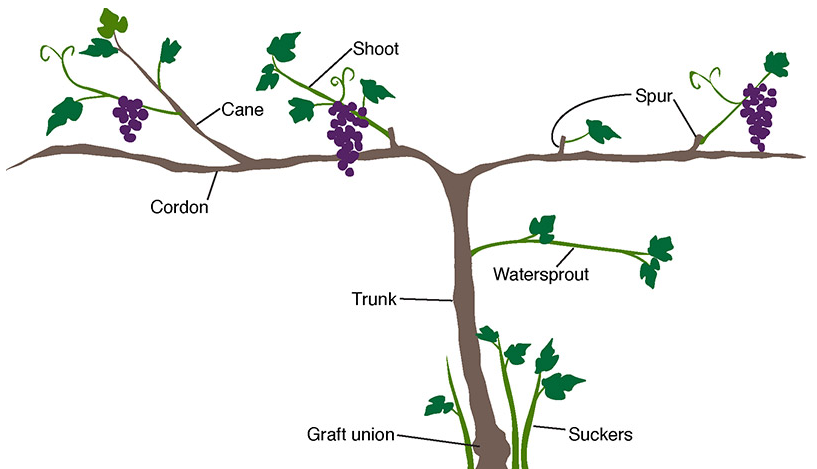
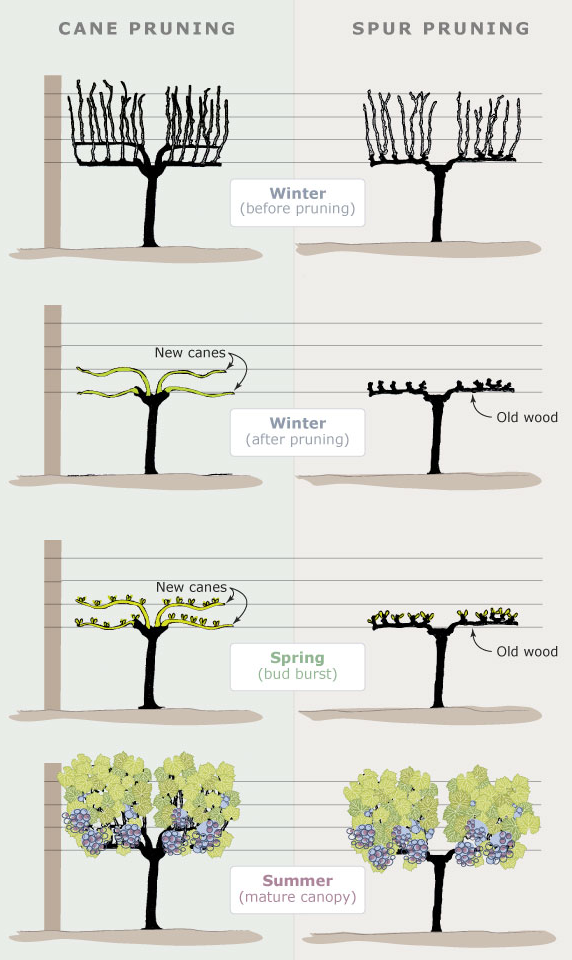
Grapevines are pruned in winter by cutting away most of the vine that is not required for the next season’s growth. Cane pruning is the most common method in New Zealand. The pruner selects two or four shoots (canes) from the previous season and trains them along the trellis wires. The other canes are removed, and new shoots sprout from the buds on the selected canes in spring.
Spur pruning is done on vines that retain one or two pairs of long canes (a permanent cordon) trained along a trellis system. Each winter, new canes that have grown along the permanent cordon are cut back to a small shoot containing two buds, known as a spur. In spring new growth develops from the buds on the spur.
It appears that the flowering season is only once a year.
Trimming (leave 15 leaves beyond each clusters):
Bunch pruning (leave only one best cluster per branch):
Large, sweet grapes are the goal when you're growing table grapes. The size of the grapes depends on the variety of grape, the health and vigor of the vine, the amount of sunlight reaching the leaves and the leaf to fruit ratio. Pruning the vines can help maintain their health and vigor, affect the amount of sunlight reaching the leaves and determine the leaf to fruit ratio. Removing clusters or reducing the size of them also has a significant effect on the size of the grapes.
Training System
Tangled, overgrown grapevines produce small, poor-quality fruit. There are several systems you can use to train grapes. All successful systems consist of cutting off most of the canes each year and training the new growth over wires or trellises so they do not become entangled. One of the simplest is cordon system, in which the trunk is cut off at the height of the wire. A single branch is allowed to grow in either direction from the trunk. New canes are combed, or draped over the wires toward the ground.
Pruning
Grapes grow 6 to 20 feet of new cane every year. Fruit is produced only on 1-year-old canes. About 90 percent of the wood should be pruned off each winter so the vine is not supporting excessive leafy growth and old wood. One-year-old canes should be cut back or removed so there are 40 to 80 buds per plant. This can be 20 buds on two to four canes or five to 10 buds on eight to 10 canes, depending on your training method. Fewer buds mean larger grapes.
Leaf Thinning
To be healthy and produce large grapes the buds that will produce new canes and fruit the following year must be exposed to sun. If they are shaded by more than three layers of leaves, remove leaves selectively so the buds close to the trunk receive direct sun. Remove only the minimum number of leaves to expose the buds. Leaves produce the sugars that make the grapes large and sweet. Do not sacrifice this year's crop for next year's growth.
Cluster Thinning and Reduction
If the vine is healthy and vigorous, the biggest factor that influences the size of the grapes is the number of fruits on the plant. With fewer fruit clusters, the grapes will become larger and sweeter. Thin the clusters during the first three weeks after fruit set. It takes 16 to 18 leaves to support a single cluster of fruit. While you don't have to do an exact count, this is a good way to estimate how many clusters to remove.
Easy: Is their life a life of sacrifice or a life of luxury?
Ask them: What is (still is) your biggest sacrifice in life?
A bit harsh? There's an alternative:
Observe what they pursuit more - a life of luxury or a life of sacrifice? Which one makes them happier? Watch how they reason/understand a life of sacrifice - do they find it joyful or ridiculous?
Sicilian Defense, one of the oldest, an opening that goes for aggressive center play, dating back to being mentioned in the 1500s, has 3 main variations: Closed (3. Nc3), Open (3. Nf3) and Alapin (3. c3)
For the Open variation, there are 3 standard lines: * 1.e4 c5 2.Nf3 d6 3.d4 cxd4 4.Nxd4 or 1.e4 c5 2. Nf3 e6 (French variation) 1.e4 c5 2.Nf3 Nc6 3.d4 (B32 line)
*The 4.Nxd4 line can be followed by .. Nf6 5. Nc3 leading into two new variations: Najdorf variation (5. .. a6) and Dragon variation (5. .. g6).
This study was originally inspired by my access to Sermons on 2 Samuel by John Calvin, translated by Douglas Kelly. I used to go to the library to transcribe this. But now that I have bought the book, which is only translated from Chapters 1-13, I will do just the summary, in addition to the online Friday Bible study I joined at LECC.ORG, which was at chapter 12 the time I first participated.
In my entries in the past, I have mentioned that I managed to reached out to Douglas Kelly, but it's been years and I don't think he's getting back at translating the rest of this. So I may have to be the one looking into the original source and maybe translate it myself.
I have both downloaded (1 Samuel, Latin) and purchased (around $40 including shipping) (2 Samuel sermons by John Calvin - complete in German). I guess I'll translate these myself after a huge head start by Douglas Kelly (2 Sam 1-13).
Question was asked on last Friday's LECC chapter 12, about the prophet, that if Jesus was said to be an Angel. Not much answered was given, I kept it to myself because I feel it was off topic, plus I was the guest: Angel just means messenger of God, so in a way Jesus was such, in another way, he would have been THE ANGEL, though qualitatively very different from the other angels that aren't humans.
With the introduction to BSF, first by my mom, and after that by Clyde from church, I participated their Online version. I came prepared - knowing that they of the non-denominational denomination and based on puritanboard's info, that they lean towards Baptist-Arminianism. ubermadchen of that forum also gave a interesting historical background: That BSF was founded for women originally. When I spoke to Clyde, I realized that I was wrong about Anne Graham (Billy Graham's daughter) being the founder of BSF, she had led such a group before, but she wasn't the founder.
While most people are familiar to BSF as a local Bible study group, I am more interested in the online Zoom ones. It's global, I can connect with Christians from around the world. But at the moment, the farthest one (Mandarin group) is a Malaysian Chinese in Brazil, when I joined the Mandarin group. It is still interesting to meet everyone so far (mostly Seattle, at the moment). I joined the Mandarin group to expose myself to Chinese Christians, since I have no other choice, being that the only reformed churches in NJ I've met are English speaking ones.
When I joined, they were on their last day, so I didn't learn or get anything other than chatting. So I immediately left the first Mandarin Zoom I joined half way through as everyone tried to share each's own "testimonies" for about 20 mins each. Another good thing with Zoom, come and go as you please I suppose. I read some of their material, mostly asking about how you feel about this, how you think of that...very shallow questioning. But it was the last material I read, so perhaps that's not the main study material, which if they had, I didn't get a chance to look at. Apparently, BSF is seasonal: i.e. From around October to May, then summer vacation. Which is when someone from the second BSF Mandarin group shared his church's (in Seattle) online Bible study for me to join when I asked if anyone knew about online Bible Study groups around the world. This Covid thing really motivates me! This also reminds me of the Monmouth Chinese church I visited, they also have Zoom sessions.
I joined the the LECC (Seattle)'s Friday Bible study for the first time and they were doing 2 Samuel 12. I think they're doing expository study, so I definitely like it, regardless if they are not reformed. They still relate biblical matters very well and are serious on studying God's word, and not just about chatting or testifying themselves, which would have been a No for me. I can look pass the Arminianism or wrong view of denomination or even rotating leading roster.
I've learned that in these situations, it's best to not talk or teach them all the time if I find them knowing less but rather, asking questions in ways that stimulate their thinking.
John Calvin did Bible study everyday, and more than once a day. So it's natural I find Bible study group everyday. Because I wished I was in Calvin's time, if not the time my Lord was on Earth. This is perhaps the best blessings there is: Zoom/Online Bible study groups. I do hope I find good ones, because there are really really bad ones, particularly the ones influenced by Charismatics. If not, at least I could consider kickstarting a reformed online group, after all, it's a good idea that the Reformed Christians haven't really done much about. Closest one was Reformed Forum and though it's very professionally done, but it's a single topic with set period, and I had to pay $400 for a single "cohort" session/class. Although, even though the entire session was somewhat nominal, but I got to set a one-on-one talk with professor Lane Tipton, that was an incredible bonus.
Since I'll be looking for expository style Bible study groups, I will start my own commentary entries accordingly, building my own commentary of the entire Bible in this journal, as I've already done for James, John, Exodus, Job, etc.
v6: When engaging in heated debate, even theological ones, be aware that God is present. We often argue as though God is not there as the chief ruler and observer. A lot of theologians argue with the same short sight.
John MacArthur's Gospel approach to Muslim. Instead of debating which religion has more denominations, MacArthur went straight to the point: I know God personally and I know He will not forgive your sins.
With all the fear of hiring in a society that loves to sue, ex-workers suing for ill-treatment, for being fired, anything goes and the court may likely side with the one who could act sadder, perhaps it's a good idea to indicate some kind of disclaimer or under oath, that I will not sue, so feel free to test and terminate me (as long as the hiring is genuine and not some cheap trick to get a small task done for free when you have no one - I think I got tricked once, should have just deleted my "testing task" after that, those sneaky bastards, but this will all be on me, not on the company, so that the ones hiring me need not be concerning themselves with such trivial things). I prove my good, I don't need the court to be on my side. And this is how much I trust them as well.
I need to start my own specialized Psalms Entry. But perhaps not all 150 chapters in one thread. I'll just break each chapter into a single entry.
Exodus 24:11 - An interesting note brought up by Phil during the fellowship meal at the buffet that I never paid enough attention to. God miraculously allowed certain people behold and commune with him, eating and drinking. This is a rather unique exception to the general principle - no man could see God directly without coming undone. John Calvin had no problem with this, if being made the exception. Although Keil and Delitzsch advised caution:
We must not go beyond the limits drawn in Exo_33:20-23 in our conceptions of what constituted the sight (חָזָה Exo_24:11) of God; at the same time we must regard it as a vision of God in some form of manifestation which rendered the divine nature discernible to the human eye. Nothing is said as to the form in which God manifested Himself.
Service Fee vs. Tip: Are they the same? Yesterday's fellowship meal at the Flaming Grill Chinese buffet restaurant was presented this minor but interesting dilemma. Some individual thought it they are not the same thing, while many of us (especially Asians) had taken for granted that service fee = tip. We knew that when the group exceed certain number of people, usually 6, the tip/gratuity/...ehem...service fee, is automatically charged. On the bill, it says service fee while listing the tip options with various %. So I can see how one would easily "fall" for it. I guess because the Asian culture really just don't like the tipping system, we are prone to equate these two as one and the same thing. I understand how one could justify otherwise - larger crowd, need more "labor" to deal with, hence service fee is required, tips not included. However, in any non-tipping countries, such as Malaysia, Australia, NZ, etc. we do not have restaurants that charge "service fee" for bigger crowd. So interesting when the bill's returned to be signed, Nadia told me (I was unaware) that it has changed from "service fee" to tip. So that may have explained why I heard that certain individual commented "this is very sneaky" - I didn't know why he said it at the time.
Secondly, one would justify that there's a difference between service fee and tip based on IRS/legality issue. Which I looked very quickly, but feel like it is really unnecessary to go there unless you are very happy at being legalistic and paying tax to the government thinking that you are some sort of patriotic citizen whose contribution matters more than it actually is. For example, Minnesota even levied law against pool tipping. The tip must go directly to the service member. I think this is ridiculous, this is the restaurant's own business, not something for the government to get its nose in.
Thanks to pastor's sermon yesterday, I realized that apparently "awesome" is used only for God, or at least in the English tradition. I shall try to be aware of this semantic.
This is a topic too large to be inserted into the PCA Ad Interim Report on Human Sexuality entry, which was the cause of this research. I will as organized as I could, make this a well informed entry on the subject. I was planning to make this short as my usual habit and principle, but based on my study, that is not possible for me to do. However, I would try to bring the main points up as early as possible, so that the tedious details would not interfere, as I want to be as thorough on this as possible.
This is a debate among reformed theologians. Or rather, opposing views are held among them because I am not aware of such debate, person to person but merely by articles written from each side of the opposing parties responding to each other, mostly indirectly. And I can assume that they would agree that this is a minor difference that a church should not split over, which I would concur. But as all things that concern God are serious, this is my due diligence: I dug through online resources, long articles, wrote to inquire a few whom I have great confidence in: i.e. Joseph Nally of Thirdmill, Alex Tseng (to my surprising gratitude and joy, he was more than willing to respond to my FB PM). I will account for my experience and all that I've learned in this long entry.
(Bavinck's The Divine and Human Nature of Christ: ...Even though He was in possession of the not-able-to-sin state of being...) Later in the same paragraph, great insight - because of His weak human nature, the possibility of being tempted and of suffering and dying. We say that it was possible that the incarnate Son to be tempted, even if we must speak of the impeccability of Christ. This is different than saying God cannot be tempted, not to mention that impeccability/peccability shouldn't even be applied to God.
I would add that though they may be on the same team (either for team peccability or team impeccability), it doesn't necessarily mean that they would agree with each other on the subject. For example: Carlton Wynne criticized Shedd's argument which DeYoung espoused, though they are both on the same team. Also, I've noticed that those who hold to the impeccability of Christ, may not have sufficient grasp of what they believe or are talking about. For example: They consider the impeccability of Christ no different to the impeccability of God. I shall share my experience of such encounters as best and constructive as possible.
First, these are established with most certainty through Reformation tradition:
The creatureliness of the Incarnate Son of God: That Jesus' human nature was created. Especially against the heresy of Apollinarianism/Apollinarism.
Impeccability of God - God is unable to sin.
Impeccability of the Second Person in the Trinity - Jesus Christ, even in His incarnation while tempted by Satan.
The last one, the Impeccability of Christ, will be the focus of this study, as I make the other aforementioned points relevant to this.
Since I am certain now I have no problem with the impeccability of Christ, though I must say I also have no problem with the peccability of Christ, I will illustrate this first with St. Augustine's 4 stages of human free will (slightly off topic: The opponent of this is John Cassian - a Semi-Pelagianist, which I won't cover here, nor have I yet looked into):
Pre-Fall Man
Post-Fall Man
Reborn Man
Glorified Man
able to sin (posse peccare)
able to sin
able to sin
able to not sin (posse non peccare)
able to not sin (posse non peccare)
unable to not sin (non posse non peccare)
able to not sin (posse non peccare)
unable to sin (non posse peccare)
Now according to Augustine's "chart", the sinless state of a man would be pre-fall and glorified stages. This is where the debate lies: Peccability advocates equate the incarnate Son's will with the pre-fall state, hence Jesus' human naturewas made/created to be the same as the first Adam, pre-fall; while impeccability advocates place Jesus's incarnate state as the glorified state, hence Jesus' human naturewas made/created to be not the same as the first Adam. This is why I have no reason to reject either impeccability or peccability of Christ just yet: Since either state does not discount Jesus as fully human. The glorification state proves that the ability to sin is not native to human nature.
Dr. Tseng explained the position for impeccability well: Adam fell and became corruptible [Human nature of] Christ was created to be impeccable, but inherited from Adam the corruptibility (physical decay) that resulted from the fall. Christ was raised to become incorruptible, as he overcame sin through death by his impeccable holiness as a man. The four stages of posse/non posse was a result of God’s decision and design by his potentia ordinata [ordained power of God, contrasting potentia absoluta - absolute power of God, what he could have done - prior to ordinata]. There is no inner necessity for God to make Christ tread the same path as Adam. In many ways, Christ was the very reverse of Adam. Adam: peccable + incorruptible Christ: impeccable + corruptible
That follows: In our glorious state, we would naturally become impeccable and incorruptible under his potentia ordinata. Although, I am not going to argue about Adam's incorruptible state (I am of the idea that Adam was originally corruptible [Genesis 3:22] but had the chance for incorruptibility, an opportunity he ruined in his fall), which is a debate for another topic. According to incorruptibility of Adam due to God's grace, I would allow it. But like peccability, I sometime fear that the definition for incorruptibility may have been abused here as well: i.e. would not have been corrupted does not imply incorruptibility. When I define impeccability or incorruptibility, I define it as not just without such "tendency", but also without the ability to, like man has no ability to fly = involarility (I made up the word from Latin). I'm not talking about flying in an airplane or gliding with a contraption. I meant that it's ontologically inaccurate for man to fly. Man is involarible. It is nonsensical to tempt a man to fly (of course, I'm not talking about the want to fly here). It's not that I would not fly, but I could not fly. Therefore, I suspect this debate may lack clear, agreeable definition on the word: peccability/impeccability. But then if there is difference in definition, it would appear that the peccability advocates realize the difference better than the impeccability advocates who hold to shallow definition: He could not have sinned vs. He would not have sinned. I shall not stop here however, in order to help clarify everything, regardless of agreement in definition.
But one would wonder, does Jesus' impeccability have to do with his divine nature or his human nature? The short answer is both, it cannot be just one or the other. Now here's the part that goes beyond logic, supra-logical: Persons sin, not nature. Jesus is the second person in the Trinity, this second person is God. However, Jesus' human nature which along with His divine nature make up His person in hypostatic union, is not part of the Trinity. The human nature of Christ had a beginning (the moment of incarnation) and is therefore not eternal: body, mind and will. In light of this, we cannot discount Christ's human nature even though his divine nature overcomes His human nature in the hypostatic union. There is certainly no question, that God is impeccable to sin. In fact, My understanding of this is closer to Stephen Tong's, as opposed to most others' view on God's sovereignty. Others would say, that even God is not absolutely free. I beg to differ, God is absolutely free, but He self-limits (freely binds) Himself. Therefore, I would not say that God is not absolutely free because He cannot sin, as others would. I would say that God is absolutely free but He is beyond hamartiology - the logical study of sin, the concept of sin. God is the creator of logic, He is the creator of the sense of sin. It is like the "Can God create a boulder so heavy He couldn't lift", you do not ask a painter if he could paint a boat that runs faster than the painter, unless you expect him to paint himself into the painting. Therefore, you do not ask if God could sin, it's simply invalid, in this sense, I agree that God is not able to sin, which is not a limitation on His sovereignty.And when God interacts with His creation, He does it in a very self-restrictive sense (potentia ordinata), such that His creatures could perceive Him and his actions. Self-imposed limitation does not constitute limitation on His sovereign will. So the divine nature pertaining to impeccability is never to be questioned.
It is fine I suppose, if one overlooks Christ's human nature, when speaking of His impeccability, nonetheless, one must not fall into the heresies of Apollinarism and turn Jesus' human nature to somewhat divine (God wearing a human "suite") or Monophysitism/Eutychian's theanthropic nature (a mixed God-man nature = tertium quid) or Monothelitism (two natures but one will), and all heresies that lead one to think that Christ's human nature is not creaturely, not created, and hence, not fully human. Therefore, if you were to say that the incarnate Christ's human nature is different from Adam's, you cannot think of that as an uncreated/non-created form. You can say that it is equivalent to the glorified state of man, which is still creaturely. This is most obviously noted in the Council of Chalcedon (451), and followed by Extra Calvinisticum, a title Lutherans gave Calvinists in their debate against Lutheran's consubstantiation: human body cannot be omnipresent in the bread, which would require divine attribute which cannot be contained in Christ's human nature and thus, outside (extra), not part of His human nature. The two natures are not confused, mixed together in hypostatic union. To argue a non-creaturely human nature, is to apply divine attribute to the human nature, which cannot be.
As a side note on the creatureliness of Christ's human nature: Now to give Stephen Tong some credit on whether Jesus' human nature was created or not, when some claimed that he is close to Apollinarianism , I would ask what was Jesus' human nature based on pertaining to the image and likeness of God? For Adam, we know that the image and likeness of God is not prototyped upon Adam, but God. But how would the image and likeness of God relate to the human nature of Jesus, whose personhood surely must have been the prototype of such himself. The image and likeness of God are not ex nihilo, so though created, Adam's nature was never totally ex-nihilo as the animals and plants and rocks, if so, what of Jesus' human nature?
One could simply conclude the Impeccability of Christ this way: Christ's personhood is different than our personhood in that not only we do not have the divine nature as Christ did, our human nature, even Adam's pre-fall nature, is not the same as that of Christ's, whose human nature was the prototype for our human nature-to-be in our glorification.
Though on the glorification state of human nature, I do wonder, what non posse peccare truly means? Do we consider it as a reduction of ability - unable to sin, as if it's a lesser state of human nature or something else? I once concluded that this was simply the grace of God's presence. God is always with us in glorification, hence God's presence overwhelms our ability to a point that sin is absolutely not possible, rather than an inability to sin. This human nature is of course, difference than the impeccability of God - God can't sin because attributes of creation do not apply to a creator.
Recent conversation with folks at church was interesting. The argument most of them presented for the impeccability of Christ begged me to ask the question: Do you think Christ's human nature was created? To which one answered: No. Because his argument for Christ's impeccability was no different than the argument for God's impeccability, which I certainly have no issue with. But Christ's impeccability is not the same as God's impeccability, simply because of Christ's dual natures. Maybe similar, but there must be a difference, as slight as they could be. As a result, I wonder perhaps there are many who hold to the impeccability of Christ, but would not accept that Christ's human nature was created, this is more of a statistical thing for me, from observation. I see no reason to, though tempting at times, staple them with the label "Apollinarianism" on this, because like some Arminians (ask them if they think they are worthy enough to be saved), they may have the right concept, but the wrong/different vocabulary to communicate, thanks to Babel. They would wonder, to some indefinite extend, how Christ laughed, cried, angered, etc. like we do.
If I were to defend the peccability of Christ simply because some have accused this as giving a sort of uncertainty to Christ's trials in temptation, as if we had to worry at first and then experienced a great relief when He passed those temptations, my argument would be: No, there was no need for worry, because possibility to sin does not imply positive probability to sin or vice versa. I can manipulate the probability of a coin toss by introducing interference so that it is always heads instead of tail, but this does not imply that the coin has no tails, it is still possible that the coin has both head and tail rather than both heads. The probability can still be zero regardless of Christ's human ability to sin, because of God's grace upon the incarnate Christ since birth. Therefore, from the position of the peccability of Christ, it was a different grace for the incarnate Son than that for Adam, as opposed (or not necessarily oppose) to Christ having a different human nature than Adam's where one was impeccable while the other was peccable, per the impeccability advocates.
When we use the term "possible to", it means having the ability to. Could. They are of the same meaning.
Also, could Christ get sick (harmed, injured, etc.)? If not, then one can only argue he's not the human in Adam's state, but in the glorified state, otherwise, that would make Christ not human. If he could get sick, then how is he impeccable on one hand and capable of getting sick (or corruptible) on the other? I find that the best solution is God's special grace again, which can also be translated into the glorified state of man. Union with God. The confusion of the two natures just seem like or close to the violation of the Chalcedonian formula as Steve Cavallaro puts it.
Now let's debate maturely:
What should be said of Christ's obedience on Earth, if He's impeccable? If He was impeccable, by definition, there is no need to speak of Christ's obedience. In what sense did Christ obey God? Of Christ's triumph and victories as man on Earth, are they who deny His peccability then not able to relate Christ's victories to their own works in Christ? Are not the experience of Holy Spirit led triumphs in worldly struggle lacking in these folks? Would this tempt us to do shallow superficial works of God and not live a life of sacrifice and love that is fully dependent on God. Or is it easier to say: That I have failed because I'm a man, Jesus did not fail, could not, because He's...well...impeccable. Not my business, I just repent and move on, no need to use an impossible model as my role model. Is there truly no relationship between Christ's HUMAN nature and ours?
Now if we are to be strict about the terms we use, then when we say, Christ was tempted, we speak of Christ as a person. Not just His human nature. But when we speak of His person, we inevitably involve the eternal Son, the divine nature, where sin is invalid such that impeccability is obvious. So in this sense, since nature do not sin, persons do, we do not consider either His human or divine nature only, but the person, whom the divine nature overpowers. As far as his human nature goes: Herman Bavinck puts it this way: his human nature became “the splendid, willing organ of his deity.” So Satan wasn't just merely tempting the man Jesus, he was also tempting the second person of the Trinity, he was tempting God. In this sense, Jesus was impeccable. But I feel that this is just a play of terminology at this point. By my current understanding, Satan never nor would ever tempt God. Satan, a pure spiritual creature, at best would disagree with or disapprove of God (i.e. book of Job), but as far as tempting goes, I fail to see such example in the Bible unless you refer to the temptation of Christ. But one could easily say, Satan was tempting the man Jesus rather than the confusion of the God Jesus due to the reference to the person of Jesus. Since the mysterious hypostatic union must be involved in this, then I think Tong's phrase is most apt: Impeccability of Christ? Ontologically (divine nature), Yes. Logically (human nature), No. Since Ontological essence supersedes the logical one, Jesus was impeccable.
According to Carlton Wynne, an impeccability advocate, Both camps run the risk of reaching their conclusions by expanding one nature beyond its proper limit such that it overtakes and diminishes the other. The most severe distortions are committed by peccability advocates who discount Christ’s divine person as the subject of Christ’s incarnate activity. Wynne continued with another quote: As Geerhardus Vos explains, “Will or intellect or emotion in the human nature could not have sinned unless the underlying person had fallen from a state of moral rectitude.”
At every turn of proper arguments for impeccability, especially done by Wynne, I was able to struggle with counter equivalence from the perspective of God's grace, God's indwelling presence with pre-fall Adam contrasting with fallen men (grace from a distant), and that of Christ's (pre-fall condition at the very least, if not more just for the sake of accommodating impeccability) so that I will still be operating with the understanding of Christ's fully human nature without fail. Therefore, when Carlton said "In assuming a human nature and all of its essential attributes, the divine Son lived, obeyed, and suffered as one whose human will was a creaturely organ of the eternal Son, assumed “inconfusedly, unchangeably, indivisibly,” and “inseparably”15 to himself as a member of the Godhead", was he referring to the creaturely organ as a member of the Godhead? Or did I read it wrong. Language can be a tricky thing. If he did, then we have serious disagreement here, being that I hold Christ's incarnate human nature not part of the trinity. I add the word incarnate here to sympathize with Tong's argument for the uncreated image and likeness of the second person of the Trinity in Christ's humanity, if we are to ponder on the meaning of "humanity" without the notion of incarnation if possible, from the perspective of the image of God, which is another can of worms, I believe. But it need not be discussed here.
Wynne basically criticized his impeccability fellows such as Shedd, for explaining Christ’s victory over temptation in terms of divine assistance, as though his divine powers commandeered his humanity at the moment of severest anguish. Of which I see parallel to my God's grace theory. And Wynne argues to situating Christ’s impeccability as a consequence of his divine person’s having taken on a human mind and will in the incarnation carries significant advantages over alternative proposals by impeccability advocates. Basically, Wynne puts emphasis of the person on the divinity more than the humanity, I believe, which maybe problematic - such as seeing the humanity (or will) as a mere creaturely organ, that may or may not be part of the Godhead. Wynne also further made this additional case to make his take on this more glorious: The divine Son was truly tempted in his humanity, making his triumph over sin and suffering all the more glorious. This I feel is more acceptable for peccability advocates rather than impeccability. There need not be degree of glory for the divine person, if nothing (i.e. human nature) of the person is peccable. I'm not even going to try to justify either sides under potentia ordinata, rather than potentia absoluta, because I think the concept of potentia absoluta though feasible logically, is still not sufficient for a Creator of logic.
I wonder if the impeccability advocates build their foundation from John Owen's works, mainly On Temptation:...Christ had the suffering part of temptation only; we have the sinning part also...which led to the discussion of what is temptation. And it was then broken down into two parts: Internal & external temptations, which was brought up in the PCA's ad interim report. In short, Christ did not have the internal temptation as we do. This internal temptation, I view as God's curse or God's turning His back in separation from mankind.
My critic on Wynne's: Our desperate situation signals our need for a Redeemer whose own volitional orientation was equally vulnerable to temptations, but whose moral rectitude impelled him to resist all of their allure. This we find in Christ alone...."Christ's unyielding will...his stubborn refusal to yield... Vulnerable, impelled, unyielding, obedience, free human will, these are the languages that implies peccability. I would love Wynne to elaborate.
Wynne's argument appear to not be far from my peccability of Christ understanding. His last statement: When we see him, we will be like him (1 John 3:2) and will no longer be able to sin. What a glorious day that will be. begs the question of the mysterious last state of human free will in God, unable to sin. Which I still struggle to understand: be it a complete removal of such ability or just simple an eternally perpetual ignorance of it in full union with God?
Conclusion, the impeccability advocates have yet to present a strong argument against peccability of Christ. The best argument is only the word play with the personhood of Christ - person sins, nature does not. But that is insufficient to uncover the humanity of Christ fully, for Satan was tempting the incarnate one, not God, or not just God if one must insist. While DeYoung and Shedd imagine a supercharged human nature from Jesus' divine nature (hence essentially equivalent to my "Grace of God theory Luke 2:40"), Wynne arguments just seem to be shifted to no different than the peccability advocates. As far as peccability goes, since all the arguments posted against the peccability advocates are largely agreed already by the peccability advocates, I feel that the peccability advocates know better at what they are talking about more than the impeccability advocates, rather than vice versa. Therefore, I don't mind taking both positions, due to the validity of both sides' claims in these ways, as long as the peccability advocates do not consider Jesus' peccability pertained to an uncertainty outcome, or the impeccability advocates do not hold Jesus' humanity, human mind, will, to be uncreated/non-creaturely. I believe it comes down to the semantic of the word impeccable after sufficient resources have been exhausted.
Practical Lessons:
This semantic is like an illusion of the Spinning Dancer (She's both spinning clockwise and also counter-clockwise: see animation below), so we best treat arguments like this with much kindness and not superiority or jealousy of knowledge.
Prayer:
I must pray that this understanding only draws me closer to God, to walk with God. That I know Thou will for me, what Thou find beautiful in me. And in all things I do, I seek impeccability before Thee, never leave me, command me to not be bored away from Thee. Have me not be led into haughtiness of shallow knowledge in loyalty such that I underestimate even the Devil, but always be confident in fear and humility of Thy knowledge in faithfulness which I am always growing in but never fully ascertain. Mortify my self indulgence, my hedonistic pursuit, but never wanting a moment of joy to be lost in Thy bosom, in Thy union, oh Blessed Savior my God! Amen!