
7/3/2026 Friday
Today, I received my headphone replacement for swimming. This one is ZOVIMAX X7 Max, $36.59, having 5.0 rating on Amazon and 60 reviews. Most bone conduction headphones have poor reviews. The last one I had was Fanisic 2026 $42.64, Amazon rating 3.8, 16 reviews, bought in February 2026 and broken (wouldn't turn on anymore) last week. I kept the charger as they look the same, so now I have 2 charging cables. I found and download a Youtube video acting as the manual for this new one (Zovimax) so I can discard the packaging and its paper manual. Digitizing everything to save physical space. The new headphone also comes with an adjustment strap, which I needed AI's help to figure out what to do with it. I didn't get the chance to use it today when I head to swim around 7pm because I needed to charge it full first.
Coming home from LA Fitness swimming around 8pm, there's a short thunder storm. I saw two trees downed: One on Rt.35 just before the Marina bridge, another around the corner to my left by the entrance into Highland Street. I felt only a little of the storm, a little wet, but it seemed that Nadia and Willy felt it bad at home. I saw the cloudy sky looked like scorched Earth as the Sun sets, thought it was beautiful so I took a shot:

7/2/2026 Thursday
In the morning, Nadia woke me up about the water leaking at the bottom of the fridge. We then found that the leak came from the rubber waterline in the back of the fridge. I felt the light spray when I went into the back of the fridge after we pulled it out of the wall. Took me about a minute to figure out it wasn't the fridge but the tiny cut in the rubber tubing (ice maker supply line). Nadia had this idea that I just cut the leaking part (of the rubber line along with the brass nut) out because it's very close to the end.
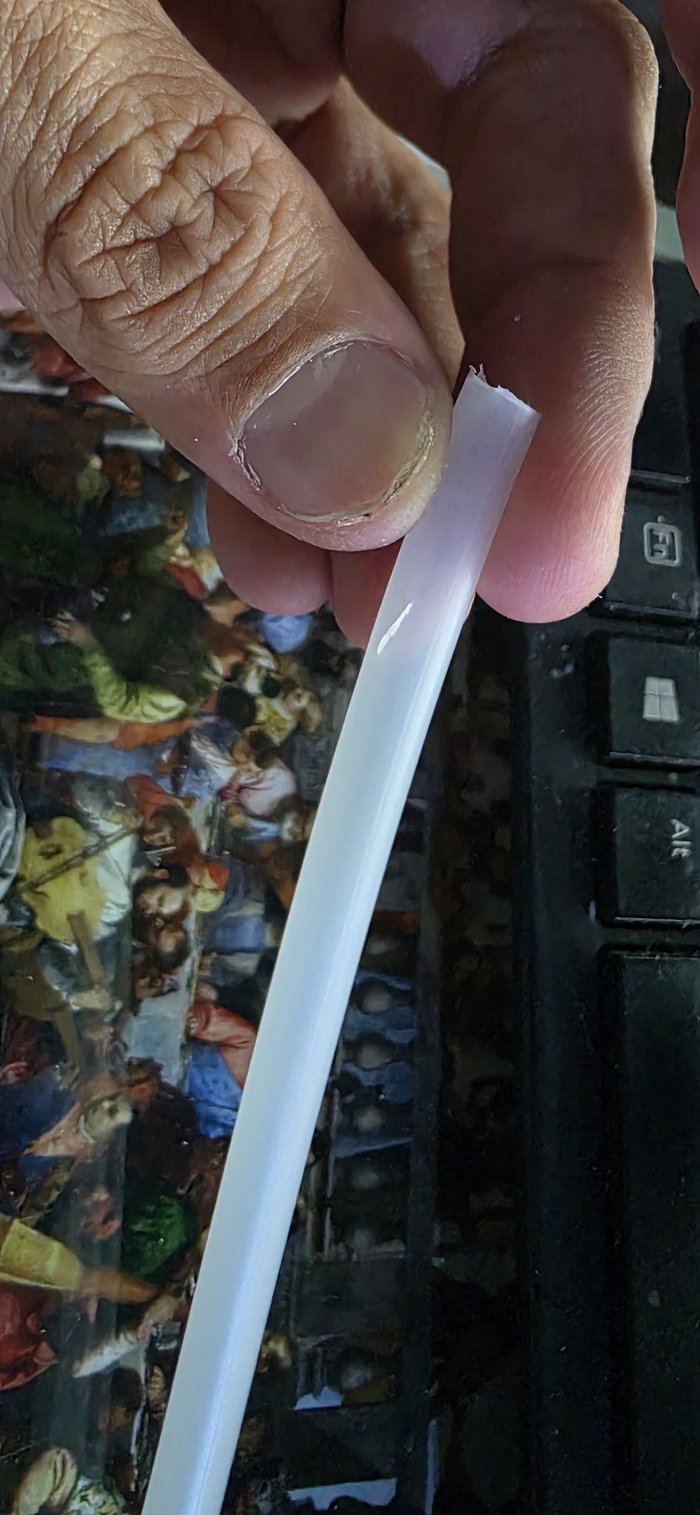
I didn't want to buy the entire supply line replacement which Home Depot seems to carry because it's integrated with the connector nuts. Thanks most part to AI and Youtube:
After unscrewing the tubing end from the pipe on the fridge's side, I was able to remove the brass ferrule first to then easily remove the rubber tube from the brass compression nut. I could then place this nut on the remaining tube coming out from the floor (the hole through the floor is only sized for the tube, not the entire nut, which was my reason not to buy the replacement from HomeDepot), by tapping the brass ferrule sleeve into the tube first, which secure the new end of the tube from leaking at the nut. So far so good. I believe I've notice similar leak for many weeks if not a couple of months and was troubled by the mystery for a few minutes and gave up on it until today.
Heat wave begins for these 3 days (Thurs to Sat) supposedly followed by thunderstorm for about a week. The heat goes as high as 109F. Living room's AC's not going to make it, so we just use upstair's AC and spend our time mostly there or outside where they have good cooling. Willy came this evening while I was on Zoom Bible study (Psalm 58 by Dan Ragusa).
At night, we went to the waterfront to watch fireworks (15 min late for the drone show and fireworks by Perth Amboy) then it's followed by another from Staten Island. The South Amboy emails I received the same day did not specify the day, but merely said that there will be fireworks at 9:15pm, so I had to assume today. We arrived at 9:30pm when Nadia insisted we go driving and parking at the park to watch it. She seemed to enjoy it as that is one of her favorite events.
7/1/2026 Wednesday
Longest chat I ever had with anyone on the phone: With Tante Lyna (from 8pm to 4am - that's 8 hours!) Mostly listening to her talk. I do enjoyed it because when else could we do this? the pouring out of what's been bottled up, and for me, without an eloquent, precise and simple way to express myself until now. Unfortunately, I could only make out 60% of what she said because her voice sounded muffled the rest of the time as if she was lying on the pillow not talking directly or speaking too close to the mic. I tried to tell her that but she didn't seem to get it. But it was alright as I could pretty much guessed the general topics she was conveying. Sounds like blaming us for leaving despite their (her) kindness. I only spoke more intently in the last 5 minutes or so, I could also finally get what I needed to say out to her: That's CCCNY (herself included) do not preach the Gospel. When she claimed that she and I preach the Gospel differently, I corrected her that I wasn't talking about methods, but the nature of preaching the Gospel, which is an ACTIVE nature, not a PASSIVE one (waiting for people to come and only after that telling them about Jesus) which is basically teaching a class, not preaching the Gospel. I added the fact that no one from CCCNY ever asked us about why we left the church until now (14 years) as evidence of my point. After the talk, I reflected. I concluded that it is true, that they do not preach the Gospel, but what she's been talking about for 8 hours (and from what I've been hearing from the past), only shows that she was preaching 人情, not 福音。I'm not discriminating 人情, but we should prioritize the Gospel over 人情, not the other way around, which is a kind of idolization. Then the Buddhists or other non-Christians have been doing a better job (i.e. Ai Ai's Catholic priest - whom she was loyal to in her faith because she was helped greatly by them). I told her that the church is getting senile, and after her and Rev. Lin, the church's days are numbered unless they wake up and train the youth to preach the Gospel, or mutate into Charismatic church, liberal or something, or shut down.
6/28/2026 Sunday
Someone brought up the Jesus Myth on Facebook and this time I just had to respond:
Why does Christianity's gospel account story resemble the stories told in several Egyptian myths? Does this mean that it's a made-up story?
C.S. Lewis, a scholar of myth at Oxtord, once stated that Christianity has a mythical radiance, but he never directly commented on Horus and Isis in a major, standalone essay.
However, he frequently discussed them as prime examples of "dying-and-rising" pagan gods. Lewis grouped them alongside similar figures like Adonis, Osiris, and Balder, whom he termed "corn kings".Lewis believed that God used these pagan stories as "shadows" or "hints" to prepare the human imagination for the coming of Christ. While his early skeptic friends viewed these similarities as proof that Jesus was merely a copied myth, Lewis (guided by J.R.R. Tolkien) eventually concluded that these pagan myths were "real, though dappled, shafts of the divine light". He famously reconciled these "parallels" with the resurrection by asserting that Jesus is the "True Myth"—the single point where myth and historical fact became one.In addition to this broad view of dying gods,
Lewis specifically evaluated ancient Egyptian religion in his book Reflections on the Psalms. Interestingly, he focused his commentary not on Isis, Horus, or standard Egyptian polytheism, but on the Pharaoh Akhenaten, who instituted a brief period of monotheism by worshiping the sun disk, Aten. Lewis admired Akhenaten's Hymn to the Sun, comparing its deep appreciation of nature and creation to some of the Jewish Psalms in the Bible.
My response:
If by Horus you referred to his virgin birth, born Dec 25, resurrection, etc. All made up in the last century, but circulated as Jesus Myth virally online. Never originally told that way. I don't know why folks don't go to "libraries" anymore.
As for dying-and-living, analogy of perpetual season cycles, longing for eternity, that would be what John Calvin called "Sensus divinitatis" and general revelation, perceived by sinners.
However, the only truth of resurrection is only found in Christianity, and eternal life in Jesus' own resurrection, which was original in history. All pagan mythologies only show the longing of life but never got it right, so technically their resurrections were not really resurrections by definition - More like reanimation, transitioning or ascension of life which is basically transitioning, etc. They never grasp the concept of becoming THE SAME living person anew, again.
I admire Lewis' pursuit of "true myth" or even William Lane Craig's "Mytho-History", but we really don't need these parallelomanias as if the Bible needs saving from secular critics. And don't get me wrong, definitely appreciate the creativity of men in Narnia and LOTR, though LOTR a bit too Roman for me (elves = Sainthood, etc.) but still...
One exercise for us is to truthfully, with hard work (now you even have the advantage of AI) and study, judge these parallelomania, i.e. True myth & Mytho-history methodology, Epic of Gilgamesh, from the Bible as historical fact, not any form of myth, breathed out by a Sovereign God. And you'll see wonders, as I've shown with just the word "resurrection" in all pagan worlds.
Perhaps now you can try this "virgin birth" idea in pagan mythologies (i.e. How Iris actually conceived Horus by turning the dead Osiris into Frankenstein for her to copulate with). Try how Buddha was conceived. Compare them all with the very concept and definition of the "VIRGIN" birth the Bible offers. You'll see which ones are childish imitations, which one is the boss, regardless of chronological order, just by definition alone.
And now you can chuckle at the term: Comparative Religion, which some hold their PhD in it with great pride. God didn't create us to do comparative religion, He wants us to judge the world! (1Co 6:2). And there is a way to do this humbly, as Moses recalled of his own humility (Num12:3). Certainly wasn't easy (you may be tempted, or you maybe misunderstood), but also not without great joy in the Lord.