
Car Accident

So I think I had what is the first car crash in my life.

Last Saturday, as I was about to park by the South Amboy boat unloading dock, my CRV suddenly launched into the wall about 3-5 feet in front.

Yes, I remember stepping on the gas.

No, I don't remember what was going through my head. Not exactly. Perhaps I was thinking I was stepping on the clutch? Or that I thought I was stepping on the reverse (I may have thought that I was too close to the car parked on the left and thus wishing to readjust my vehicle)? Or that the uneven parking lot that I was driving through just dragged the car so much that I stepped on the gas to make the car move and I was forced to feed immense gas into the engine to overcome it, not realizing that once the car escaped the sandy ground, it gained so much friction on the grassy land in addition to increased gas input, that there's no time to stop the car from hitting the wall.

From a brief look, I couldn't find any serious internal damage. Mostly cosmetic in the front. Good front bumper. The front grill looked crooked a bit, I could push and click it most of the parts back into place, sort of. And the only serious one was the damaged driver's seat airbag. It's off. Its warning light came on. The driver's seat belt cover was knocked open. The seat belt was loose, but the next day it worked again springing back tightly, I don't know how, but when I was examining it, something clicked inside and it started rolling back.

My wife will bring the car to her only favorite mechanics in Flushing.

This experience has taught me humility, in addition to be more "present" minded. I had always thought myself as a uniquely qualified driver who has never had any accident.

Also, perhaps the Lord has other purpose, like preventing me to go to boating and go home early to eat dinner with Nana.
Posted in Faults | Leave a comment

Mild Hypokinesis (Hypokinesia)

After my echo (Echocardiogram), the result was mild Hypokinesis on my left Ventricle. And this is my research thus far:

Question

Asked by Worried Mom

What Is Mild Generalized Left Ventricular Hypokinesia?

I had an Echo Doppler Panel done recently and the report impression was "mild generalized left ventricular hypokinesia." What does that mean?

Answer

Enchocardiography, or Echo for short, is a test that looks at how well your heart functions.   What is especially good about an Echo is that it gives you a dynamic (or real-time) view of the blood flow into, through, and then from your heart.ARTICLE CONTINUES BELOWSPONSOREDCrohn's Patient Video: Enough Was EnoughREAD MORE

As you may know, your heart is made of two sides, right and left.   Each side is divided into two chambers, an atrium and ventricle.   The atrium receives blood and pumps it to the ventricle which then pumps blood out of the heart.   The right side receives blood from your body and then pumps it to your lungs, while your left side receives blood from your lungs and then pumps blood to your body.   So your left ventricle, then, is the hardest working part of your heart; think of the force need to pump blood to your ENTIRE body.

Back to your results, since we've got the left ventricle part out of the way.   Mild hypokinesia basically means that the muscle of your heart does not contract as much as most peoples' hearts do.   This may sound scary, but, do not be too worried because your ejection fraction, which measures the effectiveness of your heart contractions, is still in the normal range (normal is at least 50%).

So while you do have some deficits in your heart muscle's function, you are doing okay right now.   Hypokinesis can be the result of many diseases.   You, of course with the help of your doctors, should monitor the diseases known to contribute to heart disease, including high blood pressure, high cholesterol, smoking, etc.

Posted in Biology, Reflection | Leave a comment

Understanding Triglycerides

Posted in Biology, Reflection | Leave a comment

Choosing Power Supply Adapter

To clear the confusion of what Amperage adapter to use, this is a good source to read:

Voltage Rating

If a device says it needs a particular voltage, then you have to assume it needs that voltage. Both lower and higher could be bad.

At best, with lower voltage the device will not operate correctly in a obvious way. However, some devices might appear to operate correctly, then fail in unexpected ways under just the right circumstances. When you violate required specs, you don't know what might happen. Some devices can even be damaged by too low a voltage for extended periods of time. If the device has a motor, for example, then the motor might not be able to develop enough torque to turn, so it just sits there getting hot. Some devices might draw more current to compensate for the lower voltage, but the higher than intended current can damage something. Most of the time, lower voltage will just make a device not work, but damage can't be ruled out unless you know something about the device.

Higher than specified voltage is definitely bad. Electrical components all have voltages above which they fail. Components rated for higher voltage generally cost more or have less desirable characteristics, so picking the right voltage tolerance for the components in the device probably got significant design attention. Applying too much voltage violates the design assumptions. Some level of too much voltage will damage something, but you don't know where that level is. Take what a device says on its nameplate seriously and don't give it more voltage than that.

Current Rating

Current is a bit different. A constant-voltage supply doesn't determine the current: the load, which in this case is the device, does. If Johnny wants to eat two apples, he's only going to eat two whether you put 2, 3, 5, or 20 apples on the table. A device that wants 2 A of current works the same way. It will draw 2 A whether the power supply can only provide the 2 A, or whether it could have supplied 3, 5, or 20 A. The current rating of a supply is what it can deliver, not what it will always force thru the load somehow. In that sense, unlike with voltage, the current rating of a power supply must be at least what the device wants but there is no harm in it being higher. A 9 volt 5 amp supply is a superset of a 9 volt 2 amp supply, for example.

Replacing Existing Supply

If you are replacing a previous power supply and don't know the device's requirements, then consider that power supply's rating to be the device's requirements. For example, if a unlabeled device was powered from a 9 V and 1 A supply, you can replace it with a 9 V and 1 or more amp supply.

Advanced Concepts

The above gives the basics of how to pick a power supply for some device. In most cases that is all you need to know to go to a store or on line and buy a power supply. If you're still a bit hazy on what exactly voltage and current are, it's probably better to quit now. This section goes into more power supply details that generally don't matter at the consumer level, and it assumes some basic understanding of electronics.

  • Regulated versus UnregulatedUnregulatedVery basic DC power supplies, called unregulated, just step down the input AC (generally the DC you want is at a much lower voltage than the wall power you plug the supply into), rectify it to produce DC, add a output cap to reduce ripple, and call it a day. Years ago, many power supplies were like that. They were little more than a transformer, four diodes making a full wave bridge (takes the absolute value of voltage electronically), and the filter cap. In these kinds of supplies, the output voltage is dictated by the turns ratio of the transformer. This is fixed, so instead of making a fixed output voltage their output is mostly proportional to the input AC voltage. For example, such a "12 V" DC supply might make 12 V at 110 VAC in, but then would make over 13 V at 120 VAC in.Another issue with unregulated supplies is that the output voltage not only is a function of the input voltage, but will also fluctuate with how much current is being drawn from the supply. A unregulated "12 volt 1 amp" supply is probably designed to provide the rated 12 V at full output current and the lowest valid AC input voltage, like 110 V. It could be over 13 V at 110 V in at no load (0 amps out) alone, and then higher yet at higher input voltage. Such a supply could easily put out 15 V, for example, under some conditions. Devices that needed the "12 V" were designed to handle that, so that was fine.RegulatedModern power supplies don't work that way anymore. Pretty much anything you can buy as consumer electronics will be a regulated power supply. You can still get unregulated supplies from more specialized electronics suppliers aimed at manufacturers, professionals, or at least hobbyists that should know the difference. For example, Jameco has wide selection of power supplies. Their wall warts are specifically divided into regulated and unregulated types. However, unless you go poking around where the average consumer shouldn't be, you won't likely run into unregulated supplies. Try asking for a unregulated wall wart at a consumer store that sells other stuff too, and they probably won't even know what you're talking about.A regulated supply actively controls its output voltage. These contain additional circuitry that can tweak the output voltage up and down. This is done continuously to compensate for input voltage variations and variations in the current the load is drawing. A regulated 1 amp 12 volt power supply, for example, is going to put out pretty close to 12 V over its full AC input voltage range and as long as you don't draw more than 1 A from it.Universal inputSince there is circuitry in the supply to tolerate some input voltage fluctuations, it's not much harder to make the valid input voltage range wider and cover any valid wall power found anywhere in the world. More and more supplies are being made like that, and are called universal input. This generally means they can run from 90-240 V AC, and that can be 50 or 60 Hz.
  • Minimum LoadSome power supplies, generally older switchers, have a minimum load requirement. This is usually 10% of full rated output current. For example, a 12 volt 2 amp supply with a minimum load requirement of 10% isn't guaranteed to work right unless you load it with at least 200 mA. This restriction is something you're only going to find in OEM models, meaning the supply is designed and sold to be embedded into someone else's equipment where the right kind of engineer will consider this issue carefully. I won't go into this more since this isn't going to come up on a consumer power supply.
  • Current LimitAll supplies have some maximum current they can provide and still stick to the remaining specs. For a "12 volt 1 amp" supply, that means all is fine as long as you don't try to draw more than the rated 1 A.There are various things a supply can do if you try to exceed the 1 A rating. It could simply blow a fuse. Specialty OEM supplies that are stripped down for cost could catch fire or vanish into a greasy cloud of black smoke. However, nowadays, the most likely response is that the supply will drop its output voltage to whatever is necessary to not exceed the output current. This is called current limiting. Often the current limit is set a little higher than the rating to provide some margin. The "12 V 1 A" supply might limit the current to 1.1 A, for example.A device that is trying to draw the excessive current probably won't function correctly, but everything should stay safe, not catch fire, and recover nicely once the excessive load is removed.
  • RippleNo supply, even a regulated one, can keep its output voltage exactly at the rating. Usually due to the way the supply works, there will be some frequency at which the output oscillates a little, or ripples. With unregulated supplies, the ripple is a direct function of the input AC. Basic transformer unregulated supplies fed from 60 Hz AC will generally ripple at 120 Hz, for example. The ripple of unregulated supplies can be fairly large. To abuse the 12 volt 1 amp example again, the ripple could easily be a volt or two at full load (1 A output current). Regulated supplies are usually switchers and therefore ripple at the switching frequency. A regulated 12 V 1 A switcher might ripple ±50 mV at 250 kHz, for example. The maximum ripple might not be at maximum output current.
Posted in Technical | Leave a comment

Is it sinful to Use Cuss Words

Plenty of articles out there trying to justify that the Bible speaks against curse/cuss words. I'm not talking about making profane statements or speeches which are made up of a bunch of words. I'm referring to singular word like: Fuck, Shit, Damn, etc. Of course, in other languages, they have their own set of "accepted" cuss words.

Another term for this is "dirty words".

I don't think the Bible ever teaches against this. Profanity, swearing, yes, but not specific words that somehow the majority of society has collectively accepted as "dirty words". These "dirty words" are not vain, they have meanings assigned to them. Fuck means having intercourse. Saying "having intercourse" is acceptable, but not the word "Fuck" in the social norm. Why is that? They both designate the same meaning.

So instead of shit, kids are taught to say "poo" instead. "Making love" instead of "fuck". Of course, one may even get so uncomfortable saying any of these culturally accepted substitutions and turn the whole language very general: "Going to toilet/ Taking number 2" instead of saying poo, "sleeping together" instead of fuck. The less specific the better it is. Hence, sacrificing details in speech. I think this is treading on sinful ground as well - not making clear statements.

True, there are times and places we don't just say anything we want, even if they are the truth, just like we would hide our nudity in public. So I'm not talking about such cases. Yet, often times, we hesitate in our speech to find a less offensive terms despite of non-offensive intention. I think it is not necessary.

That doesn't mean that we should now start using these "dirty" words. We should speak truthful and contently. Some people use these "dirty" words sinless, I must say, because of their own background, the kind of people they grew up with, but their hearts are purer than those who even refused to use the word "poo". Some of us have trained ourselves to use our own substitute words or languages, that is fine too, as long as we do not take those "dirty" words as if they have some bewitching essence (Idolatry/lies) nor having some unclean property (lies/calling God's creation unclean). It is the heart that is unclean, not the words. Words are just words. How we use them matters as they communicate our hearts, but the culprit would always be us, not the words themselves. So for the sake of others, we do control our speech and the choice of words we use.

Again, using of the words in itself is never a sin, just like being strong is not a sin, it is the choice of words out of our hearts and motives that would result in sin.

As a conclusion, I would not use some words if they would cause my brothers to sin, as they lack faith. I would not be sinning by merely using these words.

Posted in Theologization | Leave a comment

Pope Francis Changes the Lord's Prayer Translation

Source: https://www.foxnews.com/world/pope-francis-lords-prayer-our-father-change

The Catholic leader changed the phrase "lead us not into temptation" to "do not let us fall into temptation," as mentioned in the gospel of Matthew 6:13, because the original translation implies that God induces temptation. The change, officials said, is closer to the original intent of the prayer.

"I am the one who falls; it’s not Him pushing me into temptation to then see how I have fallen," Francis explained to Italian broadcasters about the phrase change. "A father doesn't do that, a father helps you to get up immediately. It's Satan who leads us into temptation, that's his department."

This is a no brainer: The Roman Catholic theology does not admit the noetic effect of sin. So, they presupposed that we walk not in sin at some level until we walked into the hole of temptation. But then they contradicted themselves when they say: We are all sinners. Secondly, because of such lousy theology, they could only conclude the alternative being God "pushing" me into temptation, as if I was holy to begin with.

Posted in Theologization | Leave a comment

Do the American Fundamentalists reject other churches as churches on their pulpit?

Often times I hear American pastors in the pulpit demanding that congregants should follow their leaders. As if blindly. Obviously, they are not saying that this includes heretic leaders or blindly follow incompetent leaders. They are saying this under the umbrella of trusting and obeying Christ. However, the lack of expounding the other side of the truth is always lacking among these preachers. As if they inherited a sort of intellectual shallowness from the fundamentalists in the 20s, the Bible college camps.

The lack of "go out and experience more", consideration of various problems of diverse Christians, from these preachers are deafening. I imagine if I were to ask them: What about following leaders in those charismatic churches, liberal churches, etc. I can bet that their responses would be: Those are not churches because they aren't Bible believing churches.

On the contrary, I see Joel Osteen's church as a church, I see many problem churches as churches. If there's a church that's not a church, it would be that of the Mormon's, Jehovah Witnesses', etc. These strident fundamentalists just somehow lack something beyond their comfortable never growing American inheritance to perceive a bigger picture. I see a female pastor's church as a church while many of these fundamentalists would just say: everyone is disobeying God for calling this a church.

It's as if they are moving towards legalism: mandatory family Bible study, no work on Sundays, etc. They preach all these on the pulpit but when they are facing these issues from the congregants' mouth, they would treat it as if they never preached what they preached, as if there' some exceptional clause in their preaching against these things, like doctors have to work on Sundays since Jesus heals on Sabbath; but if there are exceptional clauses, why aren't they mentioned during the sermon? Either way, somehing is wrong.

This is of course, due to lack of evangelism, outdoor preaching. Something they have educated themselves against today.

A good preaching to me is always one:
After hearing, the congregants are moved to love, praise and study God even more.

Any other kinds of preaching, are in error with God. No matter how much they claim they are of God. I can write notes against it, during these sermons, thereby still satisfying it being beneficial to me through God's blessing, but I will not refrain myself from criticising.

Posted in Theologization | Leave a comment

Vocab: Perspicacious

Kathy’s Word of the Week 2019-06-24

Weekly Brain Food brought to you by our VP of HR

perspicacious

Pronunciation:
pur-spi-key-shuhs

Definition:
having keen mental perception and understanding; discerning

As used in a sentence:
It offers quite a few facts to the perspicacious reporter.

Posted in Vocabularies | Leave a comment

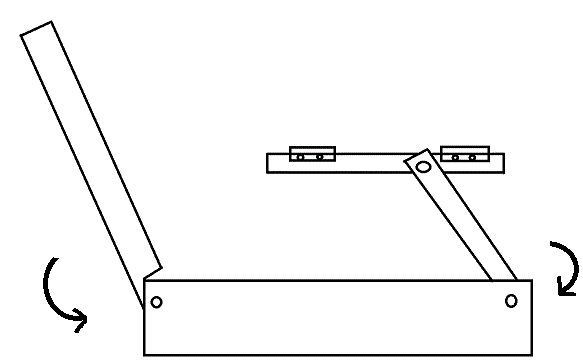
My Folding Floor Chair & Desk Idea

Basically, this folds into a briefcase. I don't think this idea is out there yet. But it's not very complicated. It's meant to be very portable. The hinges on the desk allows the desk board to be swivel open, to allow user to get into the chair. The base of the chair has a decent height at the same time providing storage room for back rest and desk as they fold into storage position.

Floor chair also benefits those who prefers to stretch their legs while sitting.

Posted in Authoring, Projects, Technical | Leave a comment

Vocab: Erudite

Kathy’s Word of the Week 2019-06-17

Weekly Brain Food brought to you by our VP of HR

erudite

Pronunciation:
er-yoo-dahyt

Definition:
having or showing great knowledge or learning

As used in a sentence:
Kathy could turn any conversation into an erudite discussion.

Posted in Vocabularies | Leave a comment