Thoughts

Today (6/10/2022) we installed the heavy 86" LG TV: 86UN9070AUD. I finally put my paranoia that the studs (wooden or something else) wouldn't hold this 100 lbs. TV because they were so easily drilled into. But so far so good, no sound of wall tearing. I think other than the luxurious size, the satisfaction comes also from human figures that look up to scale in the display.

Due to the shallowness of the Jordan River, I wish I could go check it and put my doubt about baptizo = immersion to rest once and for all. It's unlikely people of those days would venture into the middle of the river where it is deep enough to submerge.

Butterfly style / Dolphin kick, first recording, with flippers: How to improve?

Posted in Biology, Projects, Technical, Theologization | Leave a comment

Vocabulary: Urbane

Kathy’s Word of the Week

Weekly Brain Food brought to you by our CHRO

urbane

Pronunciation:

ur-beyn

Definition:

suave and sophisticated

As used in a sentence:

Someone who is urbane is polite and appears comfortable in social situations.

Posted in Vocabularies | Leave a comment

Latin Pronunciation

Starts with pronunciation: Classical vs. Ecclesiastical/church Latin vs. (English) Latin, by Dwane Thomas on his Youtube Series.

Latin LettersClassical PronunciationEcclesiastical Pronunciation
CKuhClassical unless before: e,i,ae,y => ch
Gas in GigiClassical unless before: e,i,ae,y => Juh
Hsometimes "K"Classical
JYuhClassical
VW

Posted in Vocabularies | Leave a comment

Thoughts

What Was the Old Side/New Side Controversy (Of American/colonial Presbyterianism 1741-1758 - curious reunion in Synod of 1758)? (Presbyterian in America began in 1706): Revivalists: Preaching out of bound: going into towns of other churches without the permission of local pastors, requiring ministers to give conversion narrative for ordination, etc. First General Assembly in 1789.

Somersault training:

My comment: I could barely hear the HELP in the video. It's unlikely I would notice in that atmosphere as I usually listens to my own thing on the phone. However, I would have broken that guy in half should I be made aware of it. When you yell for HELP, be sure that you shout louder, there are many willing souls who are just not really looking around.

However, later, I was reminded of Pak Tong's example on evangelizing in moments of pressure, having peace of Christ.

Posted in News | Leave a comment

Growing Grape Vine

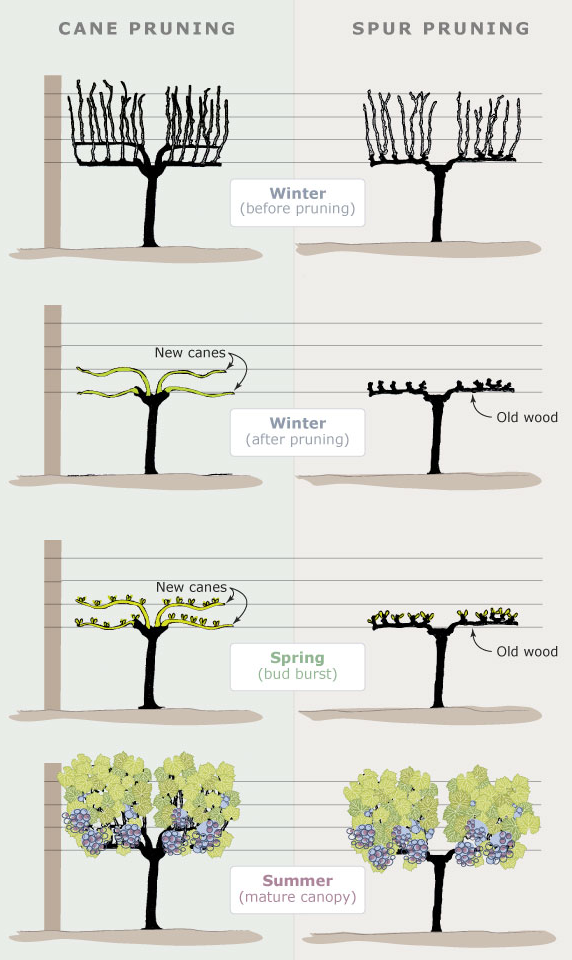
Cane vs. Spur Pruning:

Grapevines are pruned in winter by cutting away most of the vine that is not required for the next season’s growth. Cane pruning is the most common method in New Zealand. The pruner selects two or four shoots (canes) from the previous season and trains them along the trellis wires. The other canes are removed, and new shoots sprout from the buds on the selected canes in spring.

Spur pruning is done on vines that retain one or two pairs of long canes (a permanent cordon) trained along a trellis system. Each winter, new canes that have grown along the permanent cordon are cut back to a small shoot containing two buds, known as a spur. In spring new growth develops from the buds on the spur.

It appears that the flowering season is only once a year.

Trimming (leave 15 leaves beyond each clusters):

Bunch pruning (leave only one best cluster per branch):

Source: Looks legit

Does Trimming Grape Vines Produce Bigger Grapes?

ByLynn Doxon

Proper pruning and cluster thinning increases the size and sweetness of grapes.

RELATED ARTICLES

Large, sweet grapes are the goal when you're growing table grapes. The size of the grapes depends on the variety of grape, the health and vigor of the vine, the amount of sunlight reaching the leaves and the leaf to fruit ratio. Pruning the vines can help maintain their health and vigor, affect the amount of sunlight reaching the leaves and determine the leaf to fruit ratio. Removing clusters or reducing the size of them also has a significant effect on the size of the grapes.

Training System

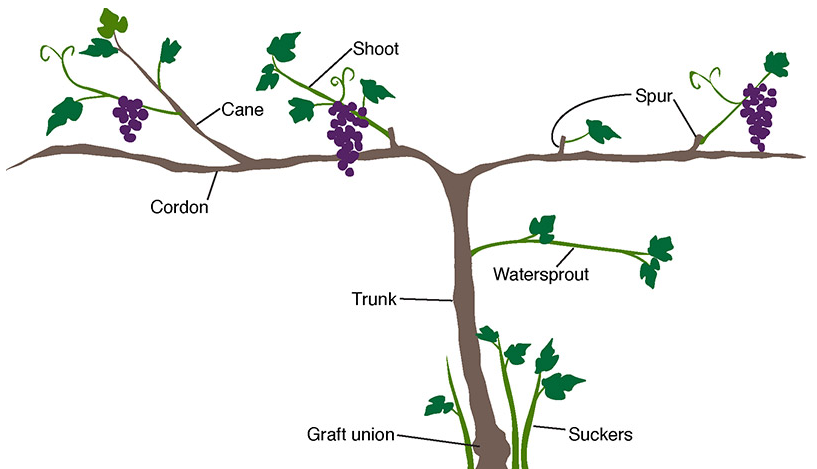
  • Tangled, overgrown grapevines produce small, poor-quality fruit. There are several systems you can use to train grapes. All successful systems consist of cutting off most of the canes each year and training the new growth over wires or trellises so they do not become entangled. One of the simplest is cordon system, in which the trunk is cut off at the height of the wire. A single branch is allowed to grow in either direction from the trunk. New canes are combed, or draped over the wires toward the ground.

Pruning

  • Grapes grow 6 to 20 feet of new cane every year. Fruit is produced only on 1-year-old canes. About 90 percent of the wood should be pruned off each winter so the vine is not supporting excessive leafy growth and old wood. One-year-old canes should be cut back or removed so there are 40 to 80 buds per plant. This can be 20 buds on two to four canes or five to 10 buds on eight to 10 canes, depending on your training method. Fewer buds mean larger grapes.

Leaf Thinning

  • To be healthy and produce large grapes the buds that will produce new canes and fruit the following year must be exposed to sun. If they are shaded by more than three layers of leaves, remove leaves selectively so the buds close to the trunk receive direct sun. Remove only the minimum number of leaves to expose the buds. Leaves produce the sugars that make the grapes large and sweet. Do not sacrifice this year's crop for next year's growth.

Cluster Thinning and Reduction

  • If the vine is healthy and vigorous, the biggest factor that influences the size of the grapes is the number of fruits on the plant. With fewer fruit clusters, the grapes will become larger and sweeter. Thin the clusters during the first three weeks after fruit set. It takes 16 to 18 leaves to support a single cluster of fruit. While you don't have to do an exact count, this is a good way to estimate how many clusters to remove.
Posted in Botany | 1 Comment

How to Detect Those who claimed Reformed yet Hide behind Prosperity Gospel?

Easy: Is their life a life of sacrifice or a life of luxury?

Ask them: What is (still is) your biggest sacrifice in life?

A bit harsh? There's an alternative:

Observe what they pursuit more - a life of luxury or a life of sacrifice? Which one makes them happier? Watch how they reason/understand a life of sacrifice - do they find it joyful or ridiculous?

Posted in Theologization | Leave a comment

Chess: Sicilian Defense

Resources: chess.com, 365chess.com (B20)

1.e4 c5

Sicilian Defense, one of the oldest, an opening that goes for aggressive center play, dating back to being mentioned in the 1500s, has 3 main variations:
Closed (3. Nc3),
Open (3. Nf3) and
Alapin (3. c3)

For the Open variation, there are 3 standard lines:
* 1.e4 c5 2.Nf3 d6 3.d4 cxd4 4.Nxd4 
or
1.e4 c5 2. Nf3 e6 (French variation)
1.e4 c5 2.Nf3 Nc6 3.d4 (B32 line)

*The 4.Nxd4 line can be followed by .. Nf6 5. Nc3 leading into two new variations:
Najdorf variation (5. .. a6) and
Dragon variation (5. .. g6).

Posted in Chess | 1 Comment

Vocabulary: Waggish

Kathy’s Word of the Week

Weekly Brain Food brought to you by our CHRO

waggish

Pronunciation:

wag-ish

Definition:

humorous in a playful, mischievous manner

As used in a sentence:

It was a waggish disposition that often got him into trouble as a child.

Posted in Vocabularies | Leave a comment

Bible Study: 2 Samuel

This study was originally inspired by my access to Sermons on 2 Samuel by John Calvin, translated by Douglas Kelly. I used to go to the library to transcribe this. But now that I have bought the book, which is only translated from Chapters 1-13, I will do just the summary, in addition to the online Friday Bible study I joined at LECC.ORG, which was at chapter 12 the time I first participated.

In my entries in the past, I have mentioned that I managed to reached out to Douglas Kelly, but it's been years and I don't think he's getting back at translating the rest of this. So I may have to be the one looking into the original source and maybe translate it myself.

I have both downloaded (1 Samuel, Latin) and purchased (around $40 including shipping) (2 Samuel sermons by John Calvin - complete in German). I guess I'll translate these myself after a huge head start by Douglas Kelly (2 Sam 1-13).

Question was asked on last Friday's LECC chapter 12, about the prophet, that if Jesus was said to be an Angel. Not much answered was given, I kept it to myself because I feel it was off topic, plus I was the guest: Angel just means messenger of God, so in a way Jesus was such, in another way, he would have been THE ANGEL, though qualitatively very different from the other angels that aren't humans.

Posted in Questions, Theologization | 18 Comments

On Bible Study Groups

With the introduction to BSF, first by my mom, and after that by Clyde from church, I participated their Online version. I came prepared - knowing that they of the non-denominational denomination and based on puritanboard's info, that they lean towards Baptist-Arminianism. ubermadchen of that forum also gave a interesting historical background: That BSF was founded for women originally. When I spoke to Clyde, I realized that I was wrong about Anne Graham (Billy Graham's daughter) being the founder of BSF, she had led such a group before, but she wasn't the founder.

While most people are familiar to BSF as a local Bible study group, I am more interested in the online Zoom ones. It's global, I can connect with Christians from around the world. But at the moment, the farthest one (Mandarin group) is a Malaysian Chinese in Brazil, when I joined the Mandarin group. It is still interesting to meet everyone so far (mostly Seattle, at the moment). I joined the Mandarin group to expose myself to Chinese Christians, since I have no other choice, being that the only reformed churches in NJ I've met are English speaking ones.

When I joined, they were on their last day, so I didn't learn or get anything other than chatting. So I immediately left the first Mandarin Zoom I joined half way through as everyone tried to share each's own "testimonies" for about 20 mins each. Another good thing with Zoom, come and go as you please I suppose. I read some of their material, mostly asking about how you feel about this, how you think of that...very shallow questioning. But it was the last material I read, so perhaps that's not the main study material, which if they had, I didn't get a chance to look at. Apparently, BSF is seasonal: i.e. From around October to May, then summer vacation. Which is when someone from the second BSF Mandarin group shared his church's (in Seattle) online Bible study for me to join when I asked if anyone knew about online Bible Study groups around the world. This Covid thing really motivates me! This also reminds me of the Monmouth Chinese church I visited, they also have Zoom sessions.

I joined the the LECC (Seattle)'s Friday Bible study for the first time and they were doing 2 Samuel 12. I think they're doing expository study, so I definitely like it, regardless if they are not reformed. They still relate biblical matters very well and are serious on studying God's word, and not just about chatting or testifying themselves, which would have been a No for me. I can look pass the Arminianism or wrong view of denomination or even rotating leading roster.

I've learned that in these situations, it's best to not talk or teach them all the time if I find them knowing less but rather, asking questions in ways that stimulate their thinking.

John Calvin did Bible study everyday, and more than once a day. So it's natural I find Bible study group everyday. Because I wished I was in Calvin's time, if not the time my Lord was on Earth. This is perhaps the best blessings there is: Zoom/Online Bible study groups. I do hope I find good ones, because there are really really bad ones, particularly the ones influenced by Charismatics. If not, at least I could consider kickstarting a reformed online group, after all, it's a good idea that the Reformed Christians haven't really done much about. Closest one was Reformed Forum and though it's very professionally done, but it's a single topic with set period, and I had to pay $400 for a single "cohort" session/class. Although, even though the entire session was somewhat nominal, but I got to set a one-on-one talk with professor Lane Tipton, that was an incredible bonus.

Since I'll be looking for expository style Bible study groups, I will start my own commentary entries accordingly, building my own commentary of the entire Bible in this journal, as I've already done for James, John, Exodus, Job, etc.

Posted in Theologization | 1 Comment